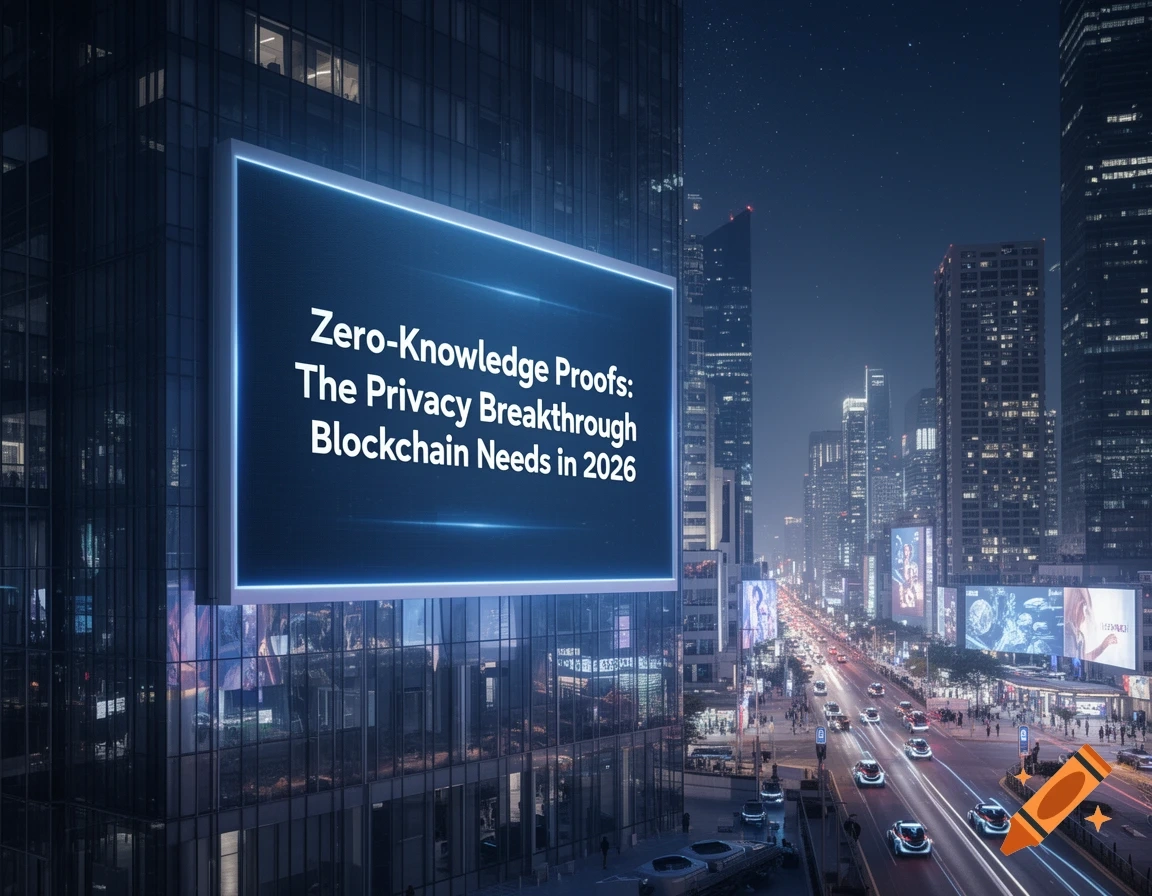
Why Zero-Knowledge Proofs Are Redefining Blockchain Privacy in 2026
Blockchain promised transparency, but that very transparency became a privacy nightmare. Every transaction, every balance, every smart contract interaction sits on a public ledger for anyone to see. By 2026, zero-knowledge proofs (ZKPs) have moved from academic papers into the heart of real-world blockchain infrastructure, solving the privacy vs. transparency dilemma once and for all. This isn’t just about hiding transaction amounts it’s about enabling entirely new classes of applications that were impossible before. Let’s walk through what zero-knowledge proofs actually are, how they work under the hood, which projects are leading the charge, and why this technology matters more than ever right now.
What Exactly Is a Zero-Knowledge Proof?
At its core, a zero-knowledge proof lets one party (the prover) convince another party (the verifier) that a statement is true without revealing any information beyond the validity of the statement itself. Think of it like proving you know the password to a door without actually saying the password. A classic real-world analogy is the “Where’s Waldo?” puzzle: you can prove you know Waldo’s location by cutting a hole in a piece of paper that only reveals Waldo, without showing the rest of the puzzle. The verifier sees Waldo and knows you must have found him, but learns nothing else about the picture.
In blockchain, this means you can prove that a transaction is valid, that you own enough funds, or that a computation was executed correctly all without exposing the actual data. This is cryptography at its most elegant, and in 2026 it’s being deployed across hundreds of decentralized applications.
The Two Main Flavors: SNARKs and STARKs
Not all zero-knowledge proofs are created equal. The two dominant families in 2026 are zk-SNARKs (Zero-Knowledge Succinct Non-Interactive Argument of Knowledge) and zk-STARKs (Zero-Knowledge Scalable Transparent Argument of Knowledge). SNARKs are known for their small proof size and fast verification, but they require a trusted setup ceremony that, if compromised, could undermine security. STARKs eliminate the trusted setup by using public randomness, making them more transparent and quantum-resistant, though their proofs are larger. Recent breakthroughs have blurred the lines projects like Mina Protocol use recursive SNARKs to keep the entire blockchain tiny (just 22 KB), while StarkWare pushes STARKs to scale Ethereum via zk-rollups. In 2026, many developers choose based on trade-offs: SNARKs for on-chain verification efficiency, STARKs for long-term security and censorship resistance.
How Zero-Knowledge Proofs Actually Work (Without the Math Overload)
Imagine you want to prove you are over 18 without revealing your exact birth date. A zero-knowledge proof can do that by encoding the statement “age ≥ 18” as an arithmetic circuit a set of mathematical constraints. The prover generates a proof that satisfies these constraints using their private input (birth date), and the verifier checks the proof against the public circuit. If the proof is valid, the verifier is convinced without ever seeing the birth date. This idea scales to complex operations like verifying thousands of transactions in a single proof. Blockchains use this to offload computation: a zk-rollup executes transactions off-chain, generates a succinct proof of validity, and submits only that proof to the main chain. The main chain verifies the proof in milliseconds, inheriting the security of the full computation without executing it. This is exactly what zkSync and Polygon zkEVM are doing in 2026, dramatically cutting gas fees and boosting throughput.
Real-World Adoption in 2026: Beyond Theory
It’s easy to get lost in the cryptography, but the real story of 2026 is adoption. Privacy coins like Zcash have used zk-SNARKs to shield transactions for years, but now the technology underpins entire Layer 2 ecosystems. DeFi protocols use ZKPs for private lending you can prove your creditworthiness without exposing your entire wallet history. Supply chain platforms like IBM Food Trust are experimenting with ZKPs to verify product authenticity while protecting business-confidential data. Even voting systems are going zero-knowledge: Vocdoni leverages ZKPs to ensure vote tally correctness without linking a ballot to an identity. In 2026, zero-knowledge proofs are not a niche they’re becoming the default privacy layer for Web3.
Setting Up a Simple zk-SNARK Circuit with Circom
Developers getting started in 2026 often use Circom, a domain-specific language for writing arithmetic circuits. Below is a basic circuit that proves you know two numbers whose product equals a public value the foundation of private credential verification.
After writing the circuit, you compile it into a Rank-1 Constraint System (R1CS), generate proving and verification keys through a trusted setup (or use a universal setup like the Powers of Tau ceremony), then produce a proof using libraries like snarkjs. The verifier only needs the proof and the public output c to check validity without ever seeing a or b. This tiny example scales to privacy-preserving login systems, age verification, and confidential transactions.
Beyond Privacy: Zero-Knowledge for Scalability
While privacy was the initial killer app, scalability has become equally important. zk-rollups, as mentioned, bundle hundreds of transactions into a single proof. In 2026, Scroll and Polygon zkEVM offer full Ethereum Virtual Machine compatibility with zero-knowledge proofs, meaning existing smart contracts can migrate with minimal changes. The result? Gas fees that were $50 in 2021 are now pennies, and decentralized exchanges settle trades almost instantly. ZK-based scalability isn’t just faster it inherits the security of the base layer, a property missing in optimistic rollups. That’s why analysts are calling 2026 the year of the “zk-superchain.”
Challenges That Still Lie Ahead
No technology is without hurdles. Zero-knowledge proofs demand intense computation to generate proofs, although hardware acceleration (FPGAs, GPUs) is making this cheaper. Trusted setup ceremonies, while often decentralized, still present a philosophical risk for some purists. And usability remains a barrier integrating ZKPs into mobile apps requires lightweight proving systems, an area where projects like RISC Zero (using a zkVM) are making strides. Also, regulatory frameworks are still catching up. In 2026, the EU’s MiCA regulation recognizes privacy technologies, but exactly how compliant zero-knowledge protocols fit remains a gray area. Despite these, the momentum is undeniable.
How Zero-Knowledge Proofs Will Shape the Rest of the Decade
Looking forward, ZKPs are poised to become the invisible layer that authenticates everything online without sacrificing privacy. Imagine logging into websites without passwords, proving your identity with a zero-knowledge proof derived from your government ID (without exposing the ID itself). Or voting in national elections where every ballot is verifiable yet anonymous. Self-sovereign identity solutions like Verifiable Credentials already rely on zero-knowledge for selective disclosure, and in 2026 we’re seeing pilots in Estonia and the Netherlands. The technology is building a future where “trust” is replaced by cryptographic proof and that’s a very different internet.
Getting Started: Practical Steps for Developers in 2026
If you’re a developer wanting to dive in, the ecosystem has never been friendlier. Start by understanding the difference between zk-SNARKs and STARKs, then pick a framework: Circom and snarkjs for SNARKs, or Cairo and Stone Prover for StarkWare’s STARKs. Experiment with a simple circuit like the multiplier above, then move to more complex stuff like proving a Merkle tree inclusion. Use testnets like Sepolia for zk-rollup deployments. The community is active zkSync Discord and the ZKProof organization are great places to ask questions. In 2026, mastering zero-knowledge proofs is no longer a niche skill; it’s becoming as fundamental as understanding smart contracts.